
Historical Clarinets and Historically Informed Performance Practice

Over more than two decades of teaching at the University of Music and Performing Arts Mannheim, Evgeni Orkin developed an intensive interest in the ways historical instruments can influence concepts of sound, playing technique, and musical understanding in instrumental teaching.
What began as a pedagogical inquiry gradually evolved into an independent artistic and research field. Historical clarinets and chalumeaux are not regarded as museum curiosities, but as a direct source of sound, articulation, phrasing, and musical language.
In 2018, Orkin published his book “Methodische Einführung in das Erlernen und die Anwendung der historischen Klarinette in historisch informierter Aufführungspraxis”. It combines organological and performance-practice foundations with a systematic playing method, as well as exercises and études composed specifically for this field. The English edition, “A Methodical Approach to Learning and Playing the Historical Clarinet and Its Usage in Historical Performance Practice”, followed in 2019.
Since then, this work has continued to expand. Alongside his engagement with original instruments and historical construction principles, Orkin now also develops and builds his own reconstructions and instrument concepts, including chalumeaux based on historical models as well as original designs and further developments. In this way, the practical study of historical instruments is closely connected with his work as a performer, teacher, and composer.
This experience also plays an increasingly important role in his compositional work. Works such as the oratorio “Briefe aus dem Schatten”, which incorporates historical instruments and their distinctive sound world, bring historically informed performance practice into dialogue with a contemporary musical language.


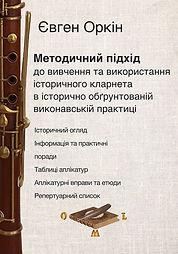
Methodische Einführung in das Erlernen und die Anwendung der historischen Klarinette Zweite verbesserte Ausgabe Dieses praxisorientierte Buch richtet sich an Klarinettistinnen und Klarinettisten, die sich mit historischen Instrumenten und historisch informierter Aufführungspraxis beschäftigen möchten. Es vermittelt einen Überblick über die Entwicklung der Klarinette und behandelt zentrale Fragen zur Wahl und praktischen Anwendung historischer Instrumente. Grafisch dargestellte Grifftabellen für unterschiedliche Instrumententypen werden durch eigens entwickelte tägliche Übungen und Etüden ergänzt, die gezielt auf charakteristische grifftechnische und spielpraktische Besonderheiten historischer Klarinetten eingehen. Hinweise aus der Aufführungspraxis, ein Repertoireführer sowie Empfehlungen zu weiterführender Fachliteratur verbinden historische Information mit unmittelbar anwendbarer Spielpraxis. Das Buch ist damit zugleich Einführung, Übemethode und Nachschlagewerk für die praktische Arbeit mit der historischen Klarinette.
A Methodical Approach to Learning and Playing the Historical Clarinet History, Practical Experience, Fingering Charts, Daily Exercises and Studies, Repertoire and Literature Guide — 2nd Edition This practice-oriented book is intended for clarinetists wishing to explore historical instruments and historically informed performance practice. It provides an overview of the historical development of the clarinet and addresses essential questions concerning the choice and practical use of period instruments. Clearly presented fingering charts for different categories of historical clarinets are complemented by specially designed daily exercises and studies, focusing on the characteristic technical and fingering challenges of these instruments. Practical advice drawn from performance experience, a repertoire guide, and references to further specialist literature connect historical knowledge with everyday playing. The book therefore serves as an introduction, a practical method, and a reference guide for musicians working with the historical clarinet.
Методичний підхід до вивчення та використання історичного кларнета в історично обґрунтованій виконавській практиці Ця практично орієнтована книга призначена для кларнетистів, які прагнуть познайомитися з історичними інструментами та принципами історично обґрунтованого виконавства. Видання містить огляд розвитку кларнета та розглядає основні питання вибору й практичного використання історичних інструментів. Наочні аплікатурні таблиці для різних типів історичних кларнетів доповнені спеціально створеними щоденними вправами та етюдами, спрямованими на характерні технічні й аплікатурні особливості цих інструментів. Практичні рекомендації, що ґрунтуються на виконавському досвіді, огляд репертуару та посилання на спеціальну літературу поєднують історичні знання з безпосередньою музичною практикою. Книга може слугувати водночас вступом, практичною методикою та довідником для роботи з історичним кларнетом.
Instruments
From this long-standing engagement with historically informed performance practice, an extensive collection of original clarinets and related instruments dating from approximately 1770 to 1930 has developed. Many of these instruments have already been used in concerts and recording projects, making them not merely collector’s items, but part of a living musical practice.
Restoration, exchange, and organological research have also led to close collaborations with specialist instrument makers, restorers, and collectors, including the Tutz family, Riccardo von Vittorelli, Frank Bernhard, and Jochen Seggelke.

Selected historical instruments

Chalumeau Consort Orkin at 415´
More ▾
This chalumeau consort was designed and built by Evgeni Orkin himself. The soprano and alto instruments were modelled on instruments by J. C. Denner, while the tenor and bass were based on a pair of chalumeaux by Kleinig, Germany, c. 1720–1730.
A small number of historical chalumeaux made of ivory have survived. In reference to this tradition, the light-coloured instruments were made from imitation ivory, evoking the exclusive aesthetic of such historical instruments.
The Bassoon de Chalumeau “Katana” is Orkin’s own design, inspired by Japanese aesthetics and created in connection with his Telemann/Shakuhachi project.


Baroque Orkin at 415'
More ▾
These four clarinets in D, C, B-flat and A were designed by Evgeni Orkin after models of early Baroque clarinets. The two-key instruments in D and C draw particularly on the rare surviving ivory clarinets by Georg Heinrich Scherer of Butzbach, whose instruments from the first half of the eighteenth century belong to the earliest surviving clarinets. Following this exceptional tradition, the light-coloured instruments were made from imitation ivory.
The three-key B-flat model is inspired by an early Amsterdam clarinet associated with Jan Boekho(u)t, around 1718, while the A clarinet represents a somewhat later stage of development. On the B-flat instrument, the additional key is operated by the right thumb; on the A instrument, by the left little finger. A two-key clarinet in C dating from around 1718 has been attributed in the literature to Jan Boekhout.
The four models are named after composers whose music is associated with these instrument types: Molter (D), Vivaldi (C), Stamitz (B-flat) and Rameau (A).


Three English Classical Clarinets, London, c. 1798–1815 at 430'
More ▾
These three original London clarinets are highly representative of English clarinet making around 1800. The group consists of an A clarinet by Longman, Clementi & Co., London, c. 1798–1801, a B-flat clarinet by James Wood, London, c. 1800, and a C clarinet by Metzler, London, c. 1812–1815. All three instruments are played at approximately a¹ = 430 Hz.
A characteristic feature of English clarinets of this period is the distinctive swelling of the lower joint in the area of the right-hand little finger, accommodating part of the key mechanism. On the early A clarinet by Longman, Clementi & Co., this form is still particularly rounded and pronounced, a feature frequently encountered on English clarinets of the late 18th century. Comparable English instruments in museum collections are explicitly described as having a bell-shaped swelling in the region of the right-hand little-finger keys.
The keywork also illustrates the development of the instrument during this period. The additional sixth key for the A–B-natural trill, referred to in English sources as the A–B-natural trill or A/B shake, was not yet consistently present on early English clarinets and only gradually became part of the expanded Classical-period key system.
Longman, Clementi & Co. was formed in 1798, when Muzio Clementi joined the established London firm of Longman. The name Longman, Clementi & Co. was used only until 1801. The surviving stamp on the clarinet, “LONGMAN CLEMENTI & COMPY / No 26 CHEAPSIDE / LONDON”, therefore allows the instrument to be dated unusually precisely to 1798–1801. A closely comparable instrument with the same firm designation is preserved in the Bate Collection in Oxford.
James Wood began working as a London woodwind-instrument maker around 1799. He became an important representative of English woodwind making and was also known for his work on keys and mouthpieces. As early as 1800, he patented a technical improvement in instrument construction. The dating of this B-flat clarinet to c. 1800 therefore fits very well with the earliest phase of his independent career.
Valentine Metzler, originally from Bingen am Rhein, settled in London toward the end of the 18th century and worked there as a woodwind-instrument maker. The mark “METZLER / LONDON / 105 WARDOUR ST.” is particularly useful for dating the instrument: Metzler is documented at this address from around 1812. The C clarinet was therefore probably made around 1812–1815 and already shows the somewhat more developed form of English Classical clarinet construction.
All three instruments were also used in the recording of the album “WanderVirtuose.” Together, they offer a particularly clear view of the development of the English clarinet from the final years of the 18th century into the early decades of the 19th century—from the distinctly rounded early form to the increasingly standardized six-key Classical clarinet.


Four Early Romantic Clarinets with Square Keys – B-flat, A, C and E-flat, c. 1820 at 430'
More ▾
These four instruments illustrate characteristic stages in the development of the clarinet during the transition from the Classical to the early Romantic period. Particularly striking are the flat rectangular or square key flaps and the increasing number of additional keys – features of a period in which the clarinet’s mechanism was rapidly expanding while strong regional traditions of instrument making were still clearly visible.
The B-flat clarinet is an anonymous original instrument, probably dating from the first decades of the nineteenth century. Its numerous square key flaps and the distinctly individual, hand-crafted construction of its mechanism are characteristic of the early Romantic clarinet around 1820.
The A clarinet is a reconstruction by Rudolf Tutz senior of Innsbruck, based on a historical instrument by Heinrich Grenser of Dresden. Grenser was one of the most important Dresden woodwind makers around 1800, and his clarinets became important models for twentieth-century historical instrument making. Tutz’s reconstruction preserves the characteristic proportions, bore and key arrangement of this Dresden type of clarinet.
The C clarinet is another anonymous original instrument. Its surviving stamp consists of a crown and the letter C. Several constructional features point towards a Dresden origin, in particular the distinctive form of the ivory ring between the upper and middle joints, the corresponding ivory ring at the bell, and the design of the F key. Comparable features are frequently encountered on Saxon, and especially Dresden, clarinets of the early nineteenth century.
The E-flat clarinet bears a heavily worn maker’s stamp surmounted by a crown. At the present stage of examination, the surviving lettering may possibly be read as “Ignaz Schifferer”, and the instrument is therefore provisionally attributed to Ignaz Schifferer. Schifferer was active as a woodwind maker in the early nineteenth century, and surviving clarinets from his workshop belong to precisely this period. Since the stamp is only fragmentarily legible, however, the attribution must remain tentative.
Together, the four clarinets form a compact panorama of clarinet making between approximately 1800 and 1830: from the Dresden tradition represented by Grenser, through different regional original instruments, to the increasingly complex key systems that paved the way for the fully developed Romantic clarinet.


Anonymous Basset Horn, probably c. 1770–1790 at 430'
More ▾
Reconstruction based on an original surviving fragment
This exceptional basset horn originated from an original anonymous lower section dating from the late eighteenth century. The surviving historical material includes the characteristic lower body section with the so-called “book” (Buch) – a construction typical of early basset horns in which the extended bore is folded back on itself before leading to the lowest register of the instrument.
The surviving fragment shows clear constructional parallels with early basset horns of the Classical period. A particularly close comparison can be found in the anonymous basset horn dated c. 1810 and illustrated by Thomas Grass and Dietrich Demus, today preserved in the Musikinstrumenten-Museum Markneukirchen. The original key arrangement of the present fragment, however, appears distinctly more archaic: there are no separate touches for the left-hand little finger, and the low basset keys were conceived consistently for operation by the thumb. This unusually early and economical mechanical concept, together with the construction of the surviving lower section, suggests a date in the last third of the eighteenth century, possibly c. 1770–1790. Since no maker’s mark survives, this dating must remain a typological attribution rather than a definitive identification.
Only the original wooden lower section of the historical instrument had survived. Using this fragment as the starting point, the basset horn was reconstructed by the instrument maker Riccardo von Vittorelli following comparable historical instruments. The missing body sections were rebuilt and integrated into a complete instrument.
A further stage of the reconstruction concerned the mechanism. The additional key system was newly conceived from a practical playing perspective, making it possible to use the full compass and fingering possibilities of a Classical basset horn. The aim was not to create a modern instrument disguised as a historical one, but to recover a playable basset horn whose construction and sound concept remain as closely connected as possible to the surviving original fragment and to comparable instruments of the late eighteenth century.
The reconstructed basset horn was also used for the recording of the CD “Mozart Opera Arias.” Its recovered sound world can therefore be experienced not only as an object of organological research, but directly in repertoire from Mozart’s musical world.
The instrument therefore combines original historical material, organological reconstruction, and the practical revival of an almost vanished instrumental type. Its unusual history also illustrates the close relationship between historical research, instrument making and historically informed performance practice.


Five Müller-Type Clarinets in A, B-flat, C, D and E-flat, c. 1830–1850 at 440'
More ▾
These five clarinets document the development of clarinet construction during the decades following Iwan Müller’s fundamental reform of the thirteen-key clarinet. From the 1820s onwards, Müller’s system spread throughout Europe and for several decades provided one of the principal foundations for the further technical development of the instrument.
The group comprises an A clarinet by Guerre of Paris, a B-flat clarinet by Kaiser of Hamburg, a C clarinet by Carl Grevé of Karlsruhe, a D clarinet by Kaiser of Hamburg, and an E-flat clarinet by Martin Frères of Paris. The five different pitches also show that, despite Müller’s concept of an “omnitonic” clarinet, complete families of differently pitched instruments continued to be used.
All five instruments fundamentally belong to the Müller tradition, with numerous closed keys, improved pads and a far more complete chromatic mechanism than that of the Classical clarinet. At the same time, they illustrate different regional interpretations and stages in the development of this system.
The B-flat clarinet by Kaiser of Hamburg is particularly interesting because it shows clear evidence of later mechanical modification. In the right-hand section, on the lower joint, two ring mechanisms were added subsequently. The traces of alteration indicate that these were not part of the original construction. Rollers on the little-finger keys also facilitate rapid changes between neighbouring keys. The instrument therefore provides a particularly clear example of the way a clarinet originally conceived within the Müller system could be technically updated during its working life to meet newer performance demands. These additions already point towards later ring-key systems, without making the instrument itself a true Sax-system clarinet.
The C clarinet by Carl Grevé of Karlsruhe, probably dating from the 1840s, should instead be regarded as a coherent instrument in its original form. Its mechanism still clearly belongs to the Müller tradition, but already shows a more refined and technically developed execution. In comparison with the earlier instruments in the group, it demonstrates how rapidly the basic Müller concept became more sophisticated in both mechanical and ergonomic terms.
The instruments by Guerre and Martin Frères of Paris represent the French branch of this development, while Kaiser of Hamburg and Carl Grevé of Karlsruhe illustrate different German approaches. The group shows that the transition from Müller’s thirteen-key clarinet to the later modern systems was not a single revolutionary step, but a gradual process shaped by regional variants, technical refinements and individual workshop solutions.
Together, these five clarinets form a particularly vivid panorama of clarinet development between approximately 1830 and 1850: firmly rooted in the Müller system, yet already moving towards the increasingly complex mechanisms of the second half of the nineteenth century.


Eugène Thibouville, Ivry-la-Bataille, c. 1875–1890
Early Boehm-system clarinet
More ▾
A remarkable early example of a French Boehm-system clarinet, illustrating the transitional stage between the older Müller clarinet and the fully developed modern Boehm instrument.
One of its most characteristic features is the absence of a separate barrel: the barrel and upper joint are made as a single integral section. The keywork likewise retains several older constructional features. Particularly striking are the strongly domed, spoon-shaped key cups or “salt-spoon keys”, a type derived directly from Iwan Müller’s key design and still frequently encountered on early Boehm-system instruments.
The clarinet is also built at an exceptionally high pitch. Its sounding pitch lies considerably above modern concert pitch, approaching a semitone above that of a modern B-flat clarinet. This strongly suggests that it may have been intended for use in a wind or military band, where high-pitch instruments remained common during the nineteenth century.
The instrument therefore represents an especially interesting early stage in the development of the Boehm clarinet: the new ring-key and interconnected mechanism is already present, while several important features of the earlier Müller tradition are still clearly retained.


Buffet Crampon “Professional” B-flat Bass Clarinet to Low C, 1977
More ▾
This Buffet Crampon bass clarinet, serial number 22063, dates from 1977 and belongs to an early generation of Buffet professional bass clarinets with an extended range down to low C.
Its most distinctive feature is the long, high-rising silver-plated bell, which differs considerably from the more compact design of later Buffet bass clarinets. The mechanism of the lowest register also represents an earlier construction: the two lowest tone holes and their keywork are arranged differently from those of later Prestige models, documenting an early stage in the development of the modern low-C mechanism.
The body is made of grenadilla, with silver-plated neck, bell and keywork. The instrument bears only the model designation “Professional”, without the later “Prestige” name.
This places the instrument at a particularly interesting stage in the development of Buffet’s professional bass clarinets: it already offers the extended range down to low C, while retaining a distinctly earlier design for the lower register. Its long metal bell and early low-C mechanism make it a characteristic example of Buffet bass-clarinet construction of the 1970s.


Hermann Sauerhering, Magdeburg – Clarinets in E-flat, C, B-flat and A, c. 1880
More ▾
These four clarinets in E-flat, C, B-flat and A were made in the workshop of Hermann Sauerhering (1841–1909) in Magdeburg and form an unusually coherent family of German clarinets dating from around 1880.
Sauerhering was a respected German woodwind maker of the late nineteenth century. From 1875 to 1880 he worked together with J. Siering under the name Siering & Sauerhering, subsequently continuing the Magdeburg workshop under his own name. Several craftsmen associated with his workshop later became connected with the further development of German clarinet making.
The instruments belong to the tradition of the Baermann–Ottensteiner system and represent a highly developed stage of German clarinet construction before its later standardisation under Oskar Oehler. Additional keys, ring mechanisms and increasingly sophisticated fingering possibilities expand the earlier German system while preserving its characteristic construction and tonal concept.
The survival of an almost complete family in four different pitches is particularly remarkable. The E-flat, C, B-flat and A clarinets demonstrate how one workshop adapted a common constructional concept to very different registers and musical functions.
The B-flat clarinet from this group was used for the recording of the Brahms Sonatas. The recording therefore employs an instrument belonging directly to the German clarinet tradition and sound world in which the music of Johannes Brahms was conceived.


Four Clarinets of the Baermann–Ottensteiner Tradition, c. 1879–1920
More ▾
These four clarinets in A, B-flat, C and E-flat provide an unusually vivid survey of the German Late-Romantic clarinet, from the immediate Ottensteiner tradition of the late nineteenth century to its continuation into the early twentieth century.
The earliest and perhaps most remarkable instrument in the group is the Ottensteiner–Hess A clarinet, Munich, c. 1879–1880. Following Georg Ottensteiner’s death in 1879, his workshop was continued by Wilhelm Hess, and surviving instruments from this brief transitional period directly connect Ottensteiner’s construction with Hess’s succession to the workshop. The mechanism of this particular instrument was subsequently further developed by Heckel.
Its provenance is particularly significant. A stamp of the Bavarian Court Opera together with an inventory number shows that the clarinet formed part of the instrument collection of the Munich Court Opera and was actually used in professional orchestral service. It is therefore not only a rare historical clarinet but also a direct witness to late nineteenth-century orchestral and operatic practice in Munich.
The B-flat clarinet by Osterried & Gerlach, Munich, was most probably made around 1900. Anton Osterried continued the Ottensteiner-Hess workshop tradition and in 1895 joined forces with Johann Gottlieb Gerlach. Osterried & Gerlach continued to build Baermann–Ottensteiner-system clarinets even as the later Oehler system was beginning to establish itself. The instrument therefore belongs directly to the historical lineage Ottensteiner – Hess – Osterried/Gerlach.
The C clarinet by Heinrich Berthold, Stuttgart, probably dates from approximately 1885–1900. Berthold was a respected South German woodwind maker and held the title of Royal Court Instrument Maker. His workshop produced clarinets, flutes, oboes and bassoons, combining meticulous craftsmanship with the increasingly sophisticated German key systems of the period.
The small E-flat clarinet by Alfred Meyer, Markneukirchen, appears to be somewhat later and probably dates from the early twentieth century, approximately 1905–1920. It demonstrates particularly well that the Baermann–Ottensteiner tradition, with its characteristic bore and mechanism, did not disappear at the end of the nineteenth century but continued to be built and played alongside the newer Oehler-system instruments.
Together, these four instruments form a small history of the German Late-Romantic clarinet: from an instrument directly connected with the Ottensteiner workshop and the Munich Court Opera, through the successor workshop of Osterried & Gerlach and the Stuttgart court-instrument tradition, to the continuation of this constructional ideal in the instrument-making centre of Markneukirchen.


V. Kohlert’s Söhne, Graslitz – B-flat Bass Clarinet, c. 1900–1915
More ▾
This Late-Romantic B-flat bass clarinet was made by the renowned firm V. Kohlert’s Söhne in Graslitz, one of the major centres of Bohemian woodwind manufacture in the Austro-Hungarian Empire.
The firm was founded by Vincenz Kohlert (1817–1900), who established his own woodwind workshop in Graslitz in 1840. His sons Rudolf, Daniel and Franz subsequently continued the business under the name V. Kohlert’s Söhne, developing it into one of Bohemia’s important manufacturers of woodwind instruments. Its production ranged from flutes and clarinets to bassoons and contrabassoons.
The construction of this bass clarinet suggests a date of approximately 1900–1915. Its long wooden body, curved metal crook and upward-facing metal bell are characteristic of European orchestral bass clarinets around the turn of the twentieth century.
A particularly interesting historical feature is its compass: the instrument extends down to written low D, rather than to the low C of many modern professional bass clarinets. This range is characteristic of earlier German and Central European bass clarinet construction and represents an important stage before the further downward extension of the modern orchestral instrument.
With its elaborate keywork, dark wooden body and large metal bell, the instrument provides a particularly vivid example of the construction and tonal ideal of the Late-Romantic bass clarinet at the beginning of the twentieth century.


Two Early Soprano Saxophones, Paris, c. 1890–1893
More ▾
Two rare French soprano saxophones from an early stage in the development of the instrument. Their construction and keywork still clearly belong to the nineteenth-century tradition, predating the later standardisation of modern saxophone mechanisms.
Martin Thibouville Aîné, Paris, c. 1890–1895 – Soprano Saxophone in C
Martin Thibouville Aîné, 91 rue de Turenne, Paris. A particularly rare soprano saxophone in C, representing the C/F branch of the saxophone family originally intended for orchestral use. This branch never achieved the lasting success of the B-flat/E-flat instruments widely adopted for military and wind-band use, making surviving French C sopranos especially uncommon today. Based on the maker’s address and period of saxophone production, the instrument can be dated approximately 1890–1895.
Evette & Schaeffer / Buffet-Crampon & Cie, Paris, 1893 – Soprano Saxophone in B-flat
Evette & Schaeffer, Ancienne Maison Buffet-Crampon & Cie, 18 & 20 Passage du Grand-Cerf, Paris. Serial no. 10216. The instrument was most probably made in 1893, during the early period of Evette & Schaeffer following their acquisition of Buffet-Crampon. It is an early B-flat soprano saxophone, with keywork characteristic of late nineteenth-century saxophone construction and still noticeably different from later standardised modern mechanisms. A closely neighbouring soprano saxophone, serial no. 10115, is likewise dated 1893.


Couesnon & Cie, Paris, c. 1910 – E-flat Baritone Saxophone, Série Monopole
More ▾
An early French baritone saxophone made by the renowned Parisian firm Couesnon & Cie, 94 rue d’Angoulême. The bell bears the characteristic inscription “Exposition Universelle de Paris 1900 – Hors Concours – Membre du Jury”, together with Couesnon’s “Monopole” trademark.
The Série Monopole represented one of Couesnon’s high-grade professional instrument lines. This saxophone retains numerous features characteristic of early saxophone construction: comparatively simple and largely exposed keywork, large key cups, long key rods and a mechanical layout still closely related to the French nineteenth-century saxophone tradition.
The reference to the Paris Exposition of 1900 provides a firm earliest date for the marking. On the basis of its construction and keywork, the instrument can reasonably be dated to c. 1905–1915, most probably around 1910. It therefore represents an important transitional stage between nineteenth-century saxophone design and the increasingly standardised instruments of the twentieth century.


Chalumeau Consort Moeck at 440´
More ▾
This chalumeau consort comes from the historic MOECK–Steinkopf series. From the 1960s onwards, MOECK in Celle produced historical woodwind instruments based on reconstructions by the pioneering instrument maker Otto Steinkopf; the chalumeaux were also modelled on surviving originals in Stockholm collections.
The four instruments shown here belong to the darker wood version. Evgeni Orkin recorded his Telemann CD on a MOECK chalumeau made in a lighter wood version.


Three Clarinets by Amlingue, Paris, c. 1780–1790 at 430'
More ▾
These three original clarinets by the Parisian instrument maker Amlingue date from the late 18th century and are pitched at approximately a¹ = 430 Hz. The group consists of a clarinet in C from the 1780s and clarinets in B-flat and A from the 1790s.
Particularly noteworthy is the construction of the early C clarinet. Here, the later customary division into lower joint and bell has not yet been introduced: the lower joint and bell are made from a single piece of wood.
Also characteristic of this period is the shared use of the same middle section, the “body,” for both A and B-flat clarinets. The central body of the instrument could be retained for both pitches, while only the lower joint with bell and the barrel with mouthpiece were exchanged. This partially modular construction principle was widespread in the late 18th century and demonstrates the considerable flexibility with which instrument makers approached bore design, pitch, and overall instrument length.
Together, these three instruments provide a particularly clear illustration of both an earlier constructional form of the C clarinet and the interchangeability of essential components between A and B-flat clarinets in late-18th-century French clarinet making.


Two Romantic Clarinets with Interchangeable Bodies, Pressburg and Fulda, c. 1810–1835 at 440'
More ▾
These two instruments provide a particularly clear illustration of the transition from the Classical to the Romantic clarinet, as well as a construction principle characteristic of the period: the interchangeable instrument. Each clarinet is accompanied by an additional central body section, a “corps de rechange” or interchangeable “body”. By exchanging this section, the instrument could be adapted for use as an A or B-flat clarinet, while substantial parts of the remaining instrument could continue to be used. This economical and practical system was widespread around 1800 and during the early nineteenth century.
The earlier instrument is an early Romantic eight-key clarinet, attributed to Franz Schöllnast, Pressburg, c. 1810–1820. It bears no unequivocal maker’s stamp, but its construction, proportions, treatment of materials and arrangement of the keywork show strong parallels with surviving instruments from the Schöllnast workshop. Franz Schöllnast (1775–1844) was one of the important woodwind makers active in Pressburg and established his own workshop there around 1810. He produced clarinets, basset horns and numerous other wind instruments and became known for technically inventive and increasingly elaborate designs.
Its eight-key mechanism already represents a significant development beyond the five- and six-key clarinets of the Classical period. Additional keys improved chromatic connections, trills and difficult cross-fingerings, considerably increasing the technical flexibility of the instrument. Clarinets of this type belong directly to the sound world of Beethoven’s period: the gradual expansion of the key system provided the greater chromatic and tonal flexibility increasingly required by the orchestral writing of Beethoven’s middle and late symphonies.
The second instrument was made by Johann Andreas Mollenhauer in Fulda and, judging from its construction and substantially expanded keywork, can plausibly be dated to approximately 1825–1835. Mollenhauer established his workshop in Fulda in 1822 and was already exhibiting clarinets, flutes and oboes in 1823. During his earlier journeyman years he had worked with several important wind-instrument makers – notably including Franz Schöllnast in Pressburg. The two instruments are therefore connected not only stylistically, but also through a direct workshop tradition.
The Mollenhauer instrument already represents the developed Romantic clarinet, with a considerably more elaborate key system. Compared with the instrument attributed to Schöllnast, its mechanism is denser and more complex: additional keys provide alternative fingerings, facilitate chromatic passages and improve the response and intonation of otherwise problematic notes. At the same time, the older principle of an interchangeable body for A and B-flat is retained – an intriguing combination of traditional modular construction and increasingly modern keywork.
Together, the two instruments document a decisive stage in the history of the clarinet: from the early Romantic eight-key instrument of c. 1810–1820 to the much more highly developed Romantic clarinet of the 1820s and 1830s. The surviving corps de rechange also demonstrates how closely A and B-flat clarinets were still conceived as parts of a single interchangeable instrumental system.


Four Clarinets by Adler, Bamberg, c. 1820–1825 at 430'
More ▾
These four original early Romantic clarinets in A, B-flat, C and E-flat are representative examples of South German clarinet making around 1820. Three of the instruments display the characteristic features of the Adler workshop in Bamberg. The A clarinet does not bear a clearly identifiable maker’s stamp, but its construction, proportions and keywork strongly suggest that it can likewise be attributed to Adler, Bamberg.
The instruments are associated with Karl Friedrich Adler (1795–1888), who moved to Bamberg in 1820 and established an important instrument-making workshop there. Comparable surviving Adler clarinets from Bamberg are dated to approximately 1820–1825.
A particularly significant feature of these instruments is the transition from the Classical clarinet to the fully developed early Romantic instrument. Compared with the five- or six-key clarinets of the late eighteenth century, their keywork is considerably more elaborate. Numerous additional keys facilitate chromatic passages, alternative fingerings and trills, allowing an increasingly even and flexible use of the instrument in all keys. This expansion of the key system was one of the defining developments in clarinet construction during the early nineteenth century.
Another striking feature is the varied use of materials. Boxwood is combined with different light and dark materials for rings, ferrules and joints, together with metal keywork. The differing forms of keys, key mounts and connecting elements give each of the four instruments its own individual constructional character, while their common origin and close chronological relationship remain clearly recognizable.
Of particular importance is the B-flat clarinet by Adler, Bamberg, which has not only survived as a historical instrument but has also been used extensively in performance and recording. Two CDs were recorded on this clarinet: “In Celebration of a Friendship”, featuring the clarinet quintets by Heinrich Joseph Baermann and Carl Maria von Weber, and a further recording devoted to works by Franz Schubert, Felix Mendelssohn Bartholdy and Carl Maria von Weber. The instrument therefore documents not only the construction of the early Romantic clarinet but also its characteristic sound in the repertoire for which this type of instrument was created.


Basset Clarinet by Friedrich August Peuckert, Breslau, c. 1805–1815 at 430'
More ▾
Original instrument in A with reconstructed basset lower joint and interchangeable B-flat body
This remarkable basset clarinet is based on an original A clarinet by Friedrich August Peuckert of Breslau, dating from the early nineteenth century. The surviving original material comprises two mouthpieces, the barrel, upper joint and middle joint, together with a characteristic pear-shaped d’Amore bell or Liebesfuß. The original lower joint, however, had not survived.
The historical context of the instrument is particularly significant. Friedrich August Peuckert was active as an instrument maker in Breslau during the early nineteenth century, and a surviving comparison clarinet is dated to approximately 1815. More importantly, Peuckert is documented as a maker of basset clarinets as early as 1806. In a contemporary notice he described a new type of B-flat clarinet developed in collaboration with the clarinettist and basset-horn player Vincent Springer of Amsterdam. The instrument was only slightly bent, descended to low C and was praised for its exceptionally beautiful tone. Later organological research identifies it as a basset clarinet and relates it to what was then called a new type of clarinet d’amour.
The surviving pear-shaped Liebesfuß of the present A instrument fits remarkably well into this historical context. The combination of clarinet and d’Amore bell was by no means unknown around 1800. Anton Stadler likewise explored such concepts, and the iconographical evidence associated with his basset clarinet shows an angled construction terminating in a distinctive d’Amore- or Liebesfuß-type bell. Since none of Stadler’s original basset clarinets survives, the precise construction of these instruments necessarily remains a matter of historically informed reconstruction.
Using the surviving original Peuckert components as the foundation, Riccardo von Vittorelli completed the instrument as a playable basset clarinet. He reconstructed the missing lower joint with its basset keywork, extending the compass into the characteristic low register of the historical basset clarinet. In addition, an interchangeable B-flat corps de rechangewas made, allowing the instrument to be used in more than one pitch, in accordance with a widespread practice of late-eighteenth- and early-nineteenth-century clarinet making.
The reconstruction of the A configuration also took into account the special form of basset clarinet associated with Anton Stadler and Mozart. Mozart’s Clarinet Quintet K. 581 and Clarinet Concerto K. 622 were conceived for Stadler’s basset clarinet in A, with its chromatically extended lower register. The well-known image from Stadler’s Riga concert programme shows a characteristically angled instrument, and historical as well as modern reconstructions have interpreted this design as incorporating a knee and a d’Amore- or Liebesfuß-type bell. B-flat basset clarinets, on the other hand, are also documented in considerably straighter forms: Peuckert’s 1806 instrument for Vincent Springer was explicitly described as “only slightly bent.”
The result is therefore not a freely invented modern instrument, but a historically informed completion of a substantially surviving original Peuckert instrument. Original components, the unusual d’Amore bell, reconstructed basset keywork and the additional B-flat interchangeable body combine to form an instrument that is simultaneously an important historical object and a practical reconstruction.
This layered history is what makes the instrument particularly significant. It documents both the remarkable experimental character of clarinet making around 1800 and the close relationship between the clarinet d’amour, basset clarinet and basset horn, while restoring to practical use an instrumental type directly connected with the sound world of Mozart, Stadler and the clarinet virtuosi of the early nineteenth century.


Alto Clarinet in F – Buffet Crampon, Paris, c. 1845 at 440'
More ▾
This exceptional instrument is specifically an alto clarinet in F by Buffet Crampon, rather than a basset horn. According to information supplied by Buffet Crampon, the instrument can be dated to approximately 1845, placing it directly within the period in which the French clarinet was developing from the Müller tradition towards the new Boehm-system mechanism created by Klosé and Buffet.
Its keywork provides a particularly clear document of this transition. Several features of the early Boehm concept are already present: the ring keys, the linked B-natural and C-sharp mechanism on the lower joint, and the characteristic disposition of several keys on the upper joint. At the same time, the mechanism had not yet reached the later standardized Boehm configuration. Particularly striking are the two keys for C and E-flat, operated by the right-hand little finger, whose arrangement still reflects earlier constructional principles. The instrument therefore occupies a remarkable position between the developed Müller clarinet and the emerging French Boehm system.
In addition to the historical Buffet Crampon maker’s stamp, several sections of the instrument bear conspicuous large numerical markings 22 and 23. These markings strongly suggest that the instrument once belonged to a military band, although the numbers alone do not yet allow a secure identification of the particular unit.
There is an important historical connection with Iwan Müller. In addition to his fundamental reform of the clarinet, Müller developed a straight alto clarinet in F, conceived as a more practical alternative to the bulky and bent basset horn. Müller himself performed in concert on this instrument, helping to establish the low clarinet as an independent solo voice. Fantasias, variations and potpourris based on popular operatic melodies formed an important part of early nineteenth-century virtuoso concert practice and provided performers with an ideal means of displaying the colour and technical possibilities of their instruments.
This historical idea became the starting point for the album Opera Alta. The recording deliberately reconnects the alto clarinet in F with early nineteenth-century virtuoso culture and the contemporary fascination with operatic melodies. It features arrangements and operatic potpourris for alto clarinet in F and string quartet. The Buffet Crampon instrument from c. 1845 represents a later stage of development than the alto clarinet on which Iwan Müller himself performed, but it stands directly within the instrumental tradition that he helped to establish.


Early Boehm-system clarinets by Buffet Crampon and Selmer Paris, 1888–1929 at 440'
More ▾
This group documents the development of the French Boehm-system clarinet from the late nineteenth century into the first decades of the twentieth century.
The large photograph shows four early Buffet Crampon clarinets in different pitches. The oldest instrument dates from 1888; the E-flat clarinet was made in 1899, and the A clarinet in 1904. Their mechanisms already represent a highly developed form of the Boehm system, while their construction still preserves characteristic features of nineteenth-century clarinet making.
One particularly striking feature is the continued absence of a separate barrel: the barrel is still integrated directly into the upper joint. These instruments therefore combine an already mature Boehm mechanism with an older constructional tradition. Their different sizes and pitches also demonstrate how extensively Buffet Crampon had already applied the Boehm system to an entire family of clarinets around 1900.
The detail photographs below also show two Selmer Paris clarinets in A and B-flat dating from 1929. These belong to a later generation of French Boehm-system clarinets and illustrate the transition toward the modern twentieth-century instrument.
Of particular interest is the early Selmer stamp with an eagle above the maker’s name. A long-standing legend among clarinetists and collectors is associated with this emblem: instruments bearing the eagle stamp are said to have been personally tested by Henri Selmer. Although this tradition cannot be regarded as firmly documented historical fact, it remains an attractive part of the history and mythology surrounding early Selmer instruments.
Together, these Buffet Crampon and Selmer clarinets form a small chronology of the French Boehm clarinet: from the Buffet instruments of 1888–1904, still strongly rooted in nineteenth-century construction, to the considerably more modern Selmer instruments of 1929.


Georg Jakob Berthold, Speyer – Clarinets in C, B-flat and A, c. 1860–1880
More ▾
This remarkable set of three clarinets in C, B-flat and A was made in the workshop of Georg Jakob Berthold (1824–1904) in Speyer, one of the highly regarded South German woodwind makers of the nineteenth century.
Born into a family of turners, Berthold gained experience during his apprenticeship and travelling years in Bayreuth, Paris, Munich and Vienna before establishing his own workshop in Speyer in 1849. His woodwind instruments enjoyed an excellent reputation. Only in 1883 did his three sons enter the business as equal partners, after which the firm traded as Georg Berthold & Söhne.
The BERTHOLD / SPEYER signature and the construction of these instruments point to the second half of the nineteenth century, most probably c. 1860–1880.
A particularly striking feature is that all three clarinets are pitched at approximately A = 438 Hz. They therefore form a rare and remarkably coherent group of instruments in three different keys but sharing essentially the same pitch standard and constructional aesthetic.
The instruments provide an excellent illustration of the highly developed South German clarinet-making tradition of the Romantic period: traditional German keywork, meticulous craftsmanship and a design dating from a period before the later standardisation of the clarinet.
As a surviving family in C, B-flat and A, the three instruments offer an unusually direct comparison of the proportions, tonal characters and constructional solutions used by a single important maker.


Three Late-Romantic Clarinets – Baermann–Ottensteiner System, c. 1880–1895
More ▾
These three clarinets in C, B-flat and A document a particularly fascinating stage in the development of the German clarinet during the late nineteenth century. All three belong to the tradition of the Baermann–Ottensteiner system, the highly developed German mechanism that evolved from the Müller clarinet and formed a direct link to the later Oehler system.
The C clarinet by Bertsch, Mannheim, probably dating from the 1880s, represents the South-West German tradition of clarinet making. Very little securely documented biographical information about the Bertsch workshop appears to have survived, making the instrument itself an especially valuable witness to regional nineteenth-century craftsmanship. Its elaborate mechanism demonstrates how sophisticated the German clarinet system had already become by this period.
The B-flat clarinet by Theodor Poppe, Dresden, was probably made around 1890–1895. Theodor Karl Poppe (1865–1934) established his own workshop in Dresden in 1887 and became a respected German woodwind maker. This instrument already stands at the threshold between the mature Baermann–Ottensteiner system and the further mechanical developments that would eventually lead to the modern German Oehler clarinet.
The A clarinet by Gustav Ludwig “Louis” Penzel, New York, probably dates from the 1880s. Penzel (1855–1920) was a German-trained instrument maker who settled in New York in 1882. Together with his brother Gustav Frederick Penzel, himself a professional clarinetist and a member of the orchestra of the Philharmonic Society of New York, from which today’s New York Philharmonic developed, he initially founded the firm G. L. Penzel & Brother.
In 1899 Louis Penzel entered into partnership with Edward Georg Müller (1869–1956), a grandson of the celebrated clarinetist and instrument reformer Iwan Müller. Their collaboration became Penzel & Müller, one of the well-known American clarinet manufacturers of the twentieth century. The A clarinet shown here therefore belongs to the early history of a workshop tradition that would later play an important role in American clarinet making.
This A clarinet was also used for the recording of the album “Liebesbriefe”, including the quintets by Johannes Brahms and Robert Schumann. The recording thus features an original Late-Romantic instrument belonging to the same German clarinet tradition in which Penzel himself had been trained.
Together, the three instruments form a fascinating panorama of the Late-Romantic clarinet: three makers, three cities on two continents, and three pitches – C, B-flat and A – united by the same fundamental constructional concept. Their elaborate keywork, additional keys, rings and interconnected mechanisms show the Baermann–Ottensteiner system in one of its most advanced forms immediately before the emergence of the modern Oehler system.


Theodore Berteling, New York – B-flat Clarinet, c. 1890
Expanded Simple System
More ▾
This clarinet was made around 1890 in the New York workshop of Theodore Berteling (1821/22–1890), an important nineteenth-century American woodwind maker of German origin. Born in Westphalia, Berteling established his New York workshop in 1848. Trading as T. Berteling & Co., the firm became a respected manufacturer of clarinets, flutes, oboes and other woodwind instruments.
The instrument belongs to the tradition of the simple system, derived from the Müller and later Albert clarinet. Its basic fingering concept is retained, but considerably expanded through additional keys, rings and mechanical connections. Instruments of this kind are generally described as expanded or enhanced simple-system clarinets. They combine the characteristic bore and fingering tradition of the older German-style clarinet with substantially increased chromatic flexibility.
This highly developed form of the simple-system clarinet remained particularly important in the United States well into the late nineteenth century. Berteling was among the New York makers who continued and refined this tradition at a high level of craftsmanship, adapting it to the requirements of American orchestral and band musicians. Comparable Berteling clarinets dating from approximately 1880–1890 are preserved today in major museum collections.
This particular instrument was also used for the recording of the album “American Dream”. The recording therefore employs an original American clarinet from the very period whose musical world the programme evokes.


Oskar Oehler – Clarinets in E-flat, B-flat and A, Berlin, c. 1890–1905
More ▾
These three original clarinets by Oskar Oehler provide a particularly clear illustration of the development from the Baermann-Ottensteiner mechanism to the German clarinet system later associated with Oehler’s name.
The E-flat clarinet, dating from around 1890, still largely retains the earlier Baermann-Ottensteiner keywork and therefore represents an early stage in the development from which Oehler’s later improvements emerged.
The B-flat and A clarinets, dating from around 1905, already show an early form of the Oehler system proper. They bear the stamp “Oskar Oehler, Berlin – Gesetzlich geschützt”. Their mechanism, however, predates the later fully developed Voll-Oehler configuration; in particular, they still lack the additional mechanism introduced to improve the low E and F.
Together, the three instruments form an exceptional ensemble illustrating the evolution of the German clarinet from the late nineteenth to the early twentieth century.


Buffet-Crampon & Cie, Paris, c. 1868 – E-flat Alto Saxophone
More ▾
Buffet-Crampon & Cie, 22 Passage du Grand-Cerf, Paris. An early French alto saxophone belonging to the first generation of saxophones manufactured by Buffet-Crampon. The company began producing its own saxophones around 1866, immediately after the expiration in France of Adolphe Sax’s original patent protection.
Its construction and keywork still stand very close to the early Sax tradition and differ in numerous details from the later standardised saxophone mechanisms of the late nineteenth century.
In addition to the maker’s mark, the instrument bears a small oval stamp “M. M. N° 1”. Comparable early Buffet-Crampon saxophones bearing similar M.M. markings are documented as instruments formerly belonging to the French military. The number therefore appears to be a military inventory or ownership mark rather than a manufacturer’s serial number.
Based on the early company address, its construction and comparison with surviving related instruments, a date of approximately 1868 is highly plausible. The instrument thus belongs to the earliest surviving phase of Buffet-Crampon saxophone production.


